
In a world that often feels fast-paced and unpredictable, it can be easy to overlook the quiet, steady presence of good. Yet within the teachings of Christian Science, good is not occasional or fleeting—it is constant, reliable, and ever-present because it is the very nature of God.
To recognize this ever-presence is not merely comforting; it is transformative. It changes how we experience our days, our relationships, and even our challenges.
God as Ever-Present Good:
At the heart of Christian Science is the understanding of God as infinite good. Mary Baker Eddy defines God in a way that leaves no room for absence or inconsistency:
“God is Love” (Science and Health with Key to the Scriptures, p. 465:8).
If God is Love—and God is All—then good is not something we wait for or hope to receive. It is already here, already active, already governing every aspect of existence.
Mary Baker Eddy further affirms:
“All is infinite Mind and its infinite manifestation, for God is All-in-all” (Science and Health, p. 468:10–11).
Often, we expect to see God’s presence in extraordinary moments—healings, breakthroughs, or dramatic changes. But the recognition of good begins in the ordinary.
A kind word. A moment of peace. A solution that comes just when needed. These are not coincidences; they are evidences of divine Love in action.
The Bible reminds us:
“Every good gift and every perfect gift is from above, and cometh down from the Father of lights” (James 1:17, KJV).
Recognizing the ever-presence of good requires spiritual perception. It asks us to look beyond appearances and cultivate awareness of what is divinely true.
Mary Baker Eddy gives practical guidance:
“Stand porter at the door of thought” (Science and Health, p. 392:24).
This includes watching for—and welcoming—evidences of good. It means choosing not to dwell on lack, frustration, or fear, and instead actively acknowledging the presence of harmony.
This is not ignoring challenges; it is seeing them from a higher standpoint, where good is still present and active.
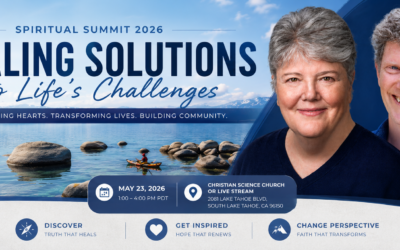
Practitioners such as James Shepherd and Caryl Emra Farkas, who both will be at our Spiritual Summit on May 23rd, have emphasized this idea in their teachings.
James Shepherd, CS often points to the importance of “recognition”—that healing and progress begin with seeing what God is already doing. Rather than trying to “fix” a situation, we can ask: “Where is the evidence of good right now?” This simple shift opens thought to the presence of divine action already underway.
Caryl Emra Farkas, CSB has highlighted that spiritual awareness is something we can actively practice in daily life. She emphasizes that recognizing God is not reserved for moments of crisis or formal prayer—it is a continuous, living awareness. As we consistently acknowledge divine Love’s presence, we begin to see more of it expressed in tangible ways.
One of the most practical ways to recognize the ever-presence of good is through gratitude. Gratitude shifts attention from what seems lacking to what is already present.
Eddy writes:
“Gratitude is much more than a verbal expression of thanks. Action expresses more gratitude than speech” (Science and Health, p. 3:25–26).
In modern life, this might look like:
* Pausing to acknowledge something good in the midst of a busy day
* Expressing appreciation even before a problem is fully resolved
* Noticing small evidences of harmony and letting them expand in thought
Gratitude is not passive—it is an active recognition of God’s presence.
As we grow in recognizing God’s ever-presence, something changes. We begin to expect good—not as wishful thinking, but as a natural outcome of divine law.
This expectancy transforms daily life:
* Challenges become opportunities to witness God’s care
* Relationships become expressions of divine Love
* Decisions become guided by divine intelligence
Life is no longer random or uncertain—it becomes purposeful and spiritually directed.
In conclusion:
The ever-presence of good is not something we create—it is something we awaken to. God, as infinite Love, is always expressing goodness, harmony, and care.
Through the teachings of Mary Baker Eddy and the insights of contemporary Christian Science practitioners, we are reminded that recognizing God is not reserved for extraordinary moments. It is a daily practice—one that opens our eyes to what has always been true.
And as we begin to notice, acknowledge, and trust this ever-present good, we find that it is not only around us—it is actively shaping our lives in ways both quiet and profound.